



“We need more leads.” It’s one of the first things a company says when sales slow down.
Sometimes they’re right, but I’ve seen plenty of situations where the company didn’t actually have a lead problem. It had a problem with what happened after the lead arrived.
The team wanted more names, meetings, and more people entering the funnel.
Meanwhile, there were already opportunities sitting in the CRM that nobody had followed up with properly.
Getting more leads feels productive. Going back through the pipeline and figuring out why existing opportunities aren’t moving is a lot less exciting than preying on the new.
But it can be much more important.
Sometimes the issue isn’t lead generation at all. Its sales pipeline management; what happens to opportunities after they enter the CRM.
Before you ask for more leads, check the ones you already have
Pull up the last few months of leads and opportunities and look at the ones that went nowhere.
What happened to them? Were they followed up with more than once? Did they actually speak with the actual decision-maker? Was there a real problem to solve? Did the prospect ever agree to the next step?
You will of course find some ‘bad leads’ that were never given much of a chance. You may also find that some leads were never going to become customers and the team spent far too much time on them.
Either way, you definitely learn something.
More leads don’t fix your weak follow-up
When a company gets a new batch of leads and starts a campaign, everyone is excited. The list gets distributed, the sequences get built, and the team starts reaching out.
A few days later, everyone is busy with the next thing.
Some prospects get one email, a voicemail, and some get followed up with three weeks late, while some never hear from the company again.
Then the team looks at the numbers and says the leads weren’t good.
They may have not been, but the process likely wasn’t good either.
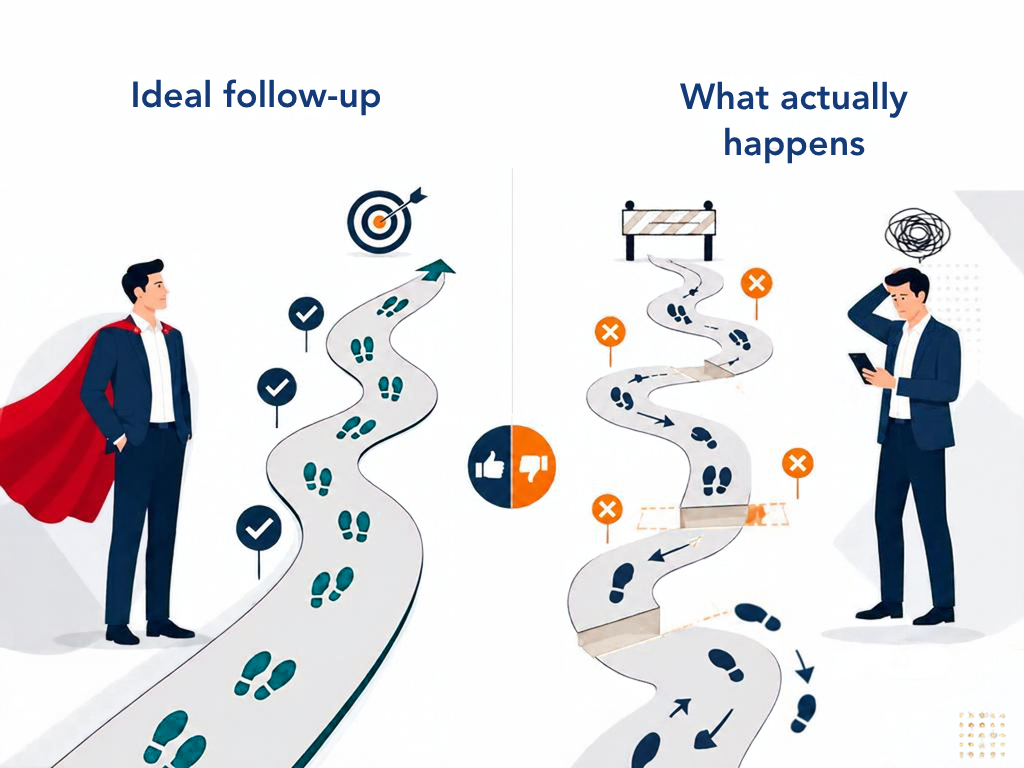
If the company isn’t consistent about how leads are worked, it becomes almost impossible to tell whether the problem is the source of the leads or what happens after they’re handed to sales.
Qualification matters more than a bigger list
A pipeline can look impressive and still be basically worthless.
I’ve seen teams celebrate having hundreds of opportunities when most had no clear next step, no closing timeline, and no real reason for the prospect to move forward.
That’s not really a pipeline; it’s really a list of golden conversations.
A qualified opportunity should have something behind it. “There should be a problem the lead cares about, a reason to act, a person involved who can influence the decision, and a next step that isn’t just ‘follow up later.”
The exact qualification process will be different for every company, but the point is that the team needs to agree on what a real opportunity looks like.
Don’t let the CRM become a graveyard
The same opportunity, same stage, same estimated close date, and same vague note about ‘checking back in.’ Weeks go by and then it changes to months.
And somehow it’s still in the forecast.
A CRM is supposed to keep the team understanding what is happening and not a hope chest that causes old opportunities to disappear.
If a prospect isn’t moving, someone needs to make a decision. Is there still a real opportunity? Does the prospect have a reason to continue? And is there a next step?
If not, send it packing.
A smaller pipeline that reflects reality is much more beneficial than a big pipeline that everyone knows is just for storage.
Sometimes the lead isn’t the problem
If you gave your team twice as many leads tomorrow, could they actually work them?
Would follow-up improve or actually happen? Would qualification improve? Would they be aware of which opportunities deserve attention? Would the team have enough time to prospect while still taking care of the opportunities already in front of them?
If the answer is no, more leads may not help. You might just be cluttering and causing more chaos.
Look at the whole path, not just the top of the mountain
Sales doesn’t start and end with lead generation. It’s part of a whole sales process: targeting, the first conversation, qualification of the lead, follow-up, discovery, the proposal, and the decision.
If something is breaking down in the middle, adding more leads into the top won’t necessarily solve it the issue.
That’s why when a sales team says, ‘We need more leads,’ the next question should be, before we get more, what is happening to the leads we already have?’
Sometimes the answer is still that you need more leads, but if the answer is that the team isn’t following up, the opportunities aren’t being qualified, or the sales process isn’t giving people a clear path forward, then you’ve found something much more useful than another list of names.
You’ve found the part of the sales process that needs attention and that’s where the real work starts.
About the Contributor, Dana AbdulHamid
Dana AbdulHamid is a Campaign Manager at TG Sales Agency with a professional background spanning the medical, business, and pharmaceutical industries. During her nearly two years with TG, she has developed experience in campaign management, business development, lead research, and sales outreach. Her cross-industry experience has strengthened her understanding of client needs, relationship building, and the role of strategic sales efforts in supporting business growth.